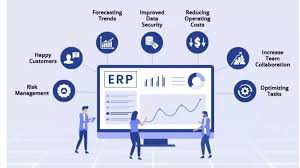
In today’s highly competitive business environment, companies are under constant pressure to reduce costs, improve performance, and respond quickly to market changes. One of the most effective tools that organizations use to achieve these goals is Enterprise Resource Planning (ERP) software. ERP systems integrate various business processes into a unified platform, enabling better coordination, automation, and data-driven decision-making.
This article explores how ERP software significantly improves business efficiency and productivity across different departments.
1. Centralized Data Management
One of the biggest challenges businesses face is managing data across multiple departments. Without integration, companies often rely on separate systems for finance, human resources, inventory, and sales. This leads to data silos, duplication, and inconsistencies.
ERP software centralizes all business data into a single system. This ensures:
Real-time access to accurate information
Reduced data duplication
Improved collaboration between departments
Better reporting and analytics
When employees can access the same up-to-date data, they spend less time searching for information and more time focusing on productive tasks.
2. Process Automation
Manual processes slow down operations and increase the risk of human error. ERP systems automate repetitive and time-consuming tasks such as:
Invoice processing
Payroll management
Order tracking
Inventory updates
Financial reporting
Automation reduces errors, speeds up workflows, and allows employees to concentrate on higher-value activities. This directly increases overall productivity and operational efficiency.
3. Improved Inventory and Supply Chain Management
Efficient inventory and supply chain management are crucial for business success. ERP software provides real-time visibility into stock levels, supplier performance, and order status.
With ERP, businesses can:
Avoid overstocking and stockouts
Optimize warehouse operations
Improve demand forecasting
Streamline procurement processes
Better control over inventory reduces waste, lowers costs, and ensures timely product delivery to customers.
4. Enhanced Financial Management
Financial management is at the core of every organization. ERP software integrates accounting, budgeting, and financial reporting into a single platform.
This enables:
Accurate financial tracking
Faster month-end closing
Real-time financial insights
Improved compliance and audit readiness
With clear financial visibility, business leaders can make informed decisions quickly, improving overall efficiency.
5. Better Decision-Making Through Real-Time Reporting
ERP systems provide dashboards and analytics tools that offer real-time insights into business performance. Managers can monitor key performance indicators (KPIs), identify bottlenecks, and adjust strategies proactively.
Instead of relying on outdated spreadsheets, decision-makers have access to:
Automated reports
Predictive analytics
Custom performance dashboards
Faster, data-driven decisions significantly boost productivity and competitive advantage.
6. Improved Collaboration Across Departments
When departments operate independently, communication gaps can slow down operations. ERP software connects teams such as sales, finance, HR, and operations within a unified system.
For example:
Sales teams can check inventory availability instantly.
Finance teams can monitor revenue in real time.
HR can manage workforce data centrally.
This integrated approach reduces delays and improves workflow coordination.
7. Scalability for Business Growth
As businesses grow, operational complexity increases. ERP software is designed to scale with the organization. Companies can add modules or users as needed without disrupting existing processes.
Scalable ERP systems help businesses:
Expand into new markets
Handle increased transaction volumes
Support multi-location operations
Manage international compliance requirements
By supporting growth efficiently, ERP software ensures sustained productivity over time.
8. Reduced Operational Costs
Efficiency improvements naturally lead to cost savings. By minimizing manual work, reducing errors, optimizing inventory, and improving resource allocation, ERP systems lower operational expenses.
Cost savings often come from:
Reduced paperwork
Lower administrative overhead
Better resource planning
Improved procurement management
Over time, these savings generate a strong return on investment (ROI).